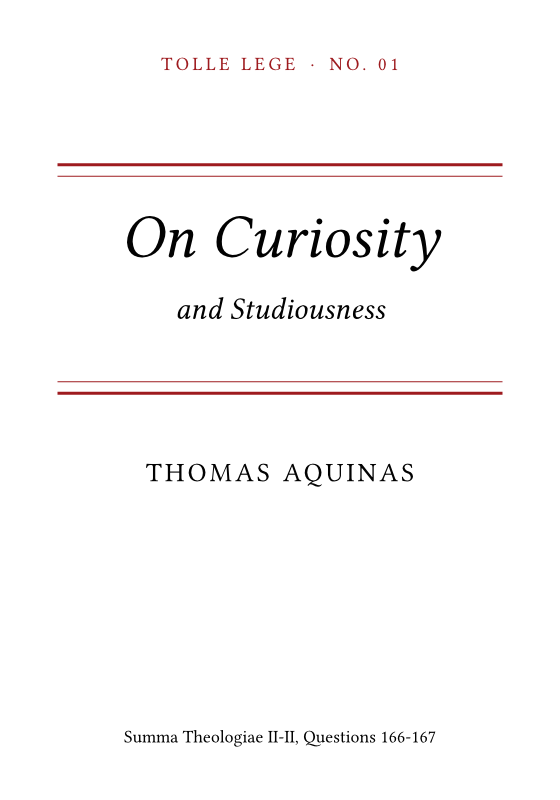
No. 01
On Curiosity
and Studiousness
Aquinas on the virtue that orders our desire to know (studiousness) and the vice that scatters it (curiosity). Eight centuries old and written for the age of the infinite scroll.
Pocket classics · 3.5 × 5 in · print, fold, sew
“Take up and read.” Augustine, Confessions VIII.12
Short public-domain texts set as pocket booklets you can make at home: a few sheets of paper, a cardstock cover, a line of thread. Every file here is free to download, print and share.
Each book needs two files: the interior (printed on text paper) and the cover (printed on cardstock). Every print run makes two copies.
No. 01
and Studiousness
Aquinas on the virtue that orders our desire to know (studiousness) and the vice that scatters it (curiosity). Eight centuries old and written for the age of the infinite scroll.
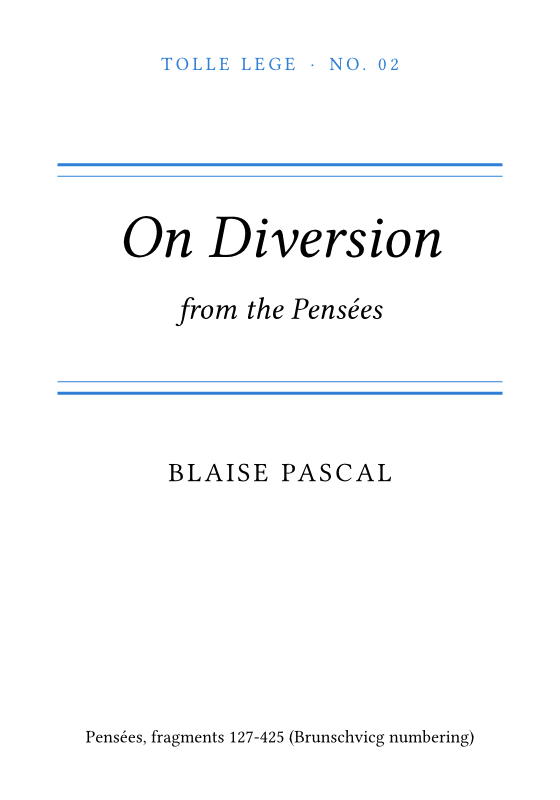
No. 02
from the Pensées
Pascal on why we cannot sit quietly in a room, why we reach for diversion instead, and why it never satisfies. A companion to No. 01, written three centuries before the smartphone.
One print run (1 cover sheet + the interior sheets) makes two books. For 25 books, print 13 runs.
Print the alignment test double-sided and hold it up to a window. If the two crosshairs line up within a millimetre or two, you are ready. If not, the README explains how to build files corrected for your printer.
Cut every sheet on the dashed line across the middle. Keep the top halves and the bottom halves in two piles: each pile is one complete book.
A small grey label in the margin says “sheet 3 of 6.” Sheet 1 goes on the outside, the last sheet in the centre.
Fold each half sheet on its own, the side marked “front” outside, through the short fold marks at the top and bottom centre. Crease with the bone folder. Score the cover before folding it.
Slide the last sheet inside the one before, and so on out to sheet 1, then put everything inside the cover. Tap the spine and the top edge on the table to square them.
Open the book flat, cover side up, and sew straight down the fold with the longest straight stitch. Do not backstitch (it perforates the paper): leave tails, pull them inside and tie them at the centre spread. No machine? A three-hole pamphlet stitch by hand, or two staples, work too.
Cut on the light grey crosses at the corners of the cover, in any order: each line runs a little way along its edge, so it is still there after you trim the other edges. A rotary trimmer or a knife with a steel straightedge both work.
Round the two corners of the open side with a 1/4 in corner rounder. Done.
Tolle Lege collects short classics on attention, study and the spiritual life, always in the most recent translation that is in the public domain, set for a pocket and made by hand. It began as booklets for a student reading group at Calvin University.
The texts are in the public domain. The layouts and editorial pages are shared under CC BY 4.0 and the code under the MIT license. Everything, including the code that builds these files, is on GitHub.